Book I read in May
Friends, I finished only one book in May. Do you want to know how many I started?
Books about grief:
- Bearing the Unbearable, by Joanne Cacciatore
- The Gentle Art of Swedish Death Cleaning, by Margareta Magnusson
- Surviving the Death of a Sibling, by T. J. Wray
- Grieving the Write Way for Siblings, by Gary Roe
Other nonfiction books:
- Breath: The New Science of a Lost Art, by James Nestor
- Your Book, Your Brand, by Dana Kaye
- Danse Macabre, by Stephen King
- Rooted: Life at the Crossroads of Science, Nature, and Spirit, by Lyanda Lynn Haupt
Fiction books:
- Peter and Wendy, by J. M. Barrie
- The Janus Stone, by Elly Griffiths
- Mistborn, by Brandon Sanderson
- Shadow and Bone, by Leigh Bardugo
Twelve! Twelve books that I started reading and then put down and wandered away from. And it’s not the fault of any of the books. I still plan to read all of them! But right now, my brain just doesn’t seem capable of settling into the kind of stillness that’s required for reading. For the first time this year - almost the first time ever - I’m behind on my annual reading challenge. Three books behind so far. Normally this would really bother me. I’ve always hated the feeling of falling behind. It induces a panic in me that I’ll never be able to catch up, even if it’s a trivial self-set goal that no one else ever knows or cares about.
I don’t know if it’s the new meds I’m on, or if it’s my sister’s death, but these days shit like that doesn’t feel very important.
What was the one book that I managed to stick with and finish?
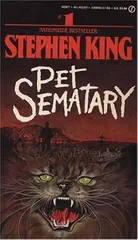
Pet Sematary by Stephen King - five stars
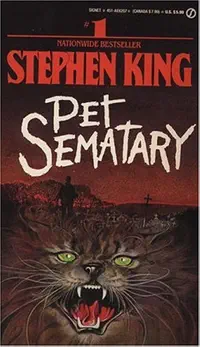
I read Pet Sematary in middle school, and I haven’t read it since, but the story is engraved in my brain. That’s probably due to the 1989 movie, which was scary as shit, especially if you were twelve years old. (I’d forgotten about the wendigo, which I think is probably because it wasn’t in the movie? And honestly the story didn’t need it.)
I might write at this at more length later, but somehow this book helped me with my grief way more than any “grief” book did.
At twelve, or whatever age I was when I first read it, Pet Sematary was just a scary book. I’d never had a child and I’d never lost a family member. I had no relevant life experience to relate to any Stephen King book on anything more than a superficial.
Reading it as an adult, having just gone through a huge loss, I can now see that the book is about grief. It’s about denial and bargaining, and dwelling in the horror of loss. Sometimes dead is better is the thesis of the book, and of course in the context of the story it mens sometimes dead is better than returning to life as a mindless, homicidal avatar of an ancient evil in the woods. But there’s another level to it. I don’t think most people who lose someone would agree with the statement them being dead is better than them being alive. That might be true in cases where someone was suffering a lot before death released them. But there are a lot of cases where dead is decidedly not better. It would be better if my sister was still alive, there’s no argument about that. But she’s not.
In the process of trying, and failing, to learn sometimes dead is better in the context of his zombie kid, what Louis is really failing to learn is acceptance. He’s stuck in denial and bargaining. In the real world, maybe dead isn’t better, but it’s still real. Pushing against the reality of it just allows infection to set in.
This is what I love about fiction. I could read a million grief memorials, or plod through a million workbooks, but none of them would provide the cartharsis that fiction can. And for me personally, the gory detail is a necessary part of the process. Memoirs and workbooks, and just about all “death content,” sanitize death. In the western world we don’t like to think about the meaty, visceral part of death–the blood on the road, the hole in the skull, the mangled remains in the coffin. But I need that. I need to face it.
So thanks, Stephen King! I felt a lot better after reading your book.
