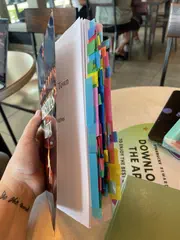
I wrote a book
Contrary to appearances, I do more with my time than make clothes and watch Veronica Mars.
I wrote a book.
I don’t write much about my writing here, even though it’s the primary thing I spend my time on. It’s not that I have nothing to say about it—I have a lot of thoughts about writing. But, I don’t know, maybe I feel like I don’t have the credentials yet to speak about it like I’m some kind of expert.
Also, writing is pretty boring. Trust me when I say that updates about sewing pajamas are about a thousand times more entertaining than updates about writing my book. There are only so many times you can say, “I didn’t feel like writing today, but I did anyway and it turned out okay.”
But since I’ve actually written a book, start to finish, and that’s a thing a lot of people want to do, why not talk about how I did it?
There’s something in my brain that’s like a dog that needs exercise.
Not Writing a Book - 2006-2019
When my younger child was still a baby, I made the decision not to return to work. I’d be a stay-at-home-mom, and in my “free time” I’d do the thing I’d always wanted most to do: write a book.
Well, folks, that child is now going to college, and I only just now actually finished a book. And it’s not like I wasn’t trying for all sixteen-plus years. It just took that long for me to get good enough at it, I guess, to produce something I felt worth seeing through to the end. I’ve written several first drafts of other books, and they’re in various stages of revision, but this is the first book I’ve gotten to the point that I’m comfortable with it entering the world unsupervised.
Outline and First Draft - 2019
This particular book began as an experiment: could I write an outline for a novel that went all the way to the end. Historically, I’d been great at starting novels, and absolutely terrible at finishing them. I’d get lost about twenty- to thirty-thousand words in, and have absolutely no idea what should happen next. (Turns out this is pretty common — it’s known as the “mushy middle” and most writers I know experience it.)
But at the time, I didn’t plan to ever write that book. I was already in the middle several other books, including a horror novel and an epic fantasy. I’d been restarting the horror novel for about seven years at that point. (I’m a famous re-starter of things. I almost never reach the end of video games because I enjoy restarting too much.) I’d written a full draft of the fantasy during NaNoWriMo in 2017 but it was a total mess that needed a complete rewrite.
I kept backing myself into confusing corners and not knowing how to get out of them. So I wanted to try outlining an “easier” book — a straightforward, set-in-the-real world story with only one point of view. So I chose an idea for a YA novel that I’d been keeping in the back of my head for a while. This story combined some autobiographical elements centered around being a teenager with an anxiety disorder who gets involved in unhealthy relationship, with the death of a child in an abandoned Christmas-themed amusement park, which was inspired by a true crime I came across on a podcast. The idea had all the necessary components of a story: setting, characters, and a central event. Could I flesh them out into scenes to create a full-fledged outline of a book?
Using Larry Brook’s book Story Engineering, I spent three days thinking my way through the story, deciding where the tentpoles would be (inciting incident, context-shifting midpoint, dark moment), and then figuring out how to connect them with scenes that both developed the characters and moved the plot from point A to point B.
In the end, I had an outline I was pretty proud of. This might actually make a pretty good YA novel, I thought. But I didn’t plan on being a YA novelist. I wanted to write speculative fiction.
But around that time, I picked up a piece of writing advice somewhere. The advice was never publish your first book—the reason being that your first book is not going to be very good. It’s basically practice.
Well, if I wasn’t going to publish my first book anyway, then it didn’t matter if it was in my preferred genre or not. If I was going to write a practice book, why not the one I’d written the practice outline for?
Over the course of the next few months, I turned my outline into a book. It didn’t look exactly like the outline in the end, because as you’re writing you think of new things that are better than what you’d thought of before. But the outline was a road map that got me to the destination.
There, I did it! I wrote a practice book. Then I put it away and went back to my real books.
Revision - 2023
Five years later, my sister died.
In that time, I’d given up on the horror novel, and done a total rewrite of the epic fantasy. I was in the process of revising that during the COVID lockdown, but between the pandemic and the California wildfires and Trump and the election, my mental health was gradually spiraling lower and lower. I couldn’t bring myself to deal with the heavy themes in my epic fantasy. I pivoted to a more lighthearted adventure fantasy, something fun that wouldn’t remind me of how bleak the real world was. That had actually been going really well, despite my reservations about starting a new book, yet again, without having finished any of the previous ones.
(An aside here to mention that, throughout the lockdown, I was Rachael Herron’s 90 Day classes. Signing up for them was the best writing decision I ever made — it completely changed the way I think about writing. If you want to write a novel or a memoir, you should sign up.)
I was in the middle of a revision when my sister died unexpectedly and my whole world was upended.
I knew that I couldn’t stop writing. My mental health deteriorates rapidly if I’m not writing. I could take a little time off, but not as much time as it was going to take to work through my grief. And I knew that my fun fantasy romp of flying airships and talking trees was not the right vessel for the pain I was going through. I didn’t want to ruin that book for myself by associating it with my grief.
So I dug out my “practice” YA novel. It had a lot of my own pain in it already, which made it the perfect container for this new pain.
Now the first story I ever wrote a complete outline for would also become the first story I ever did a complete revision of. Still using the Story Engineering model as a guide, I moved things around. I deleted scenes and added scenes and completely rewrote scenes. I introduced some characters and removed others.
It took about three months to write the first draft, and a year to write the second. I wrote an entire book’s worth of words (91,514 to be exact) about the book, in the form of journal entries and brainstorms and notes to myself, as I was revising. Revision is, in a lot of ways, harder than drafting. And it uses a totally different part of your brain. First drafting is fun, loose, creative (as long as you can get past the fact that you know your book is a fucking mess and you’re not going to do anything about it yet). You’re just making shit up and putting it on paper, entertaining yourself. Revision is much more technical. It’s like surgery: you’re taking the book apart and putting it back together, discarding the parts that don’t work and inserting new parts that (hopefully) do work.
Drafting is fun, but revision is rewarding. It’s where you start to see your book for the first time rising out of the muck of the messy first draft like gold from a stream bed. I wish that I’d learned that lesson a long time ago —l ike twenty years ago would have been great — because what was stopping me all those years that I was trying and failing to finish first drafts was the belief that books come out right the first time. As soon as I saw that the book wasn’t coming out right, I’d stop and try to start over, fixing whatever problem I’d run into, only to inevitably run into another one. This is a lesson that writing classes don’t teach you. They’ll teach you how to polish a scene, how to make “lyrical” sentences, but they won’t teach you how to excavate an entire book from a pile of words. But that’s where the real work is.
Completion - 2024
After the first major revision, I did yet more revisions. First, I had to cut a bunch of words, to get the manuscript down from 110,000 to closer to 90k (I wound up around 94k in the end). Then I had to clean it up, searching for verbal tics like passive verbs, repetitive phrases, overused words, cliches and typos. I made it as good as I knew I could get it, keeping in mind the whole time Hank Green’s MO of only trying to be 80% perfect. Other eyes than mine would be able to get me closer to 100%. Then I sent an ePub file of the book to my generous friends and relatives who had agreed to read it and tell me what they thought.
Throughout the month of August, their feedback has been trickling in, and I’m now ready to do one more revision. By September I will be sending it to agents, and going back to my fun fantasy adventure while I wait to see if anyone bites.
It’s possible no one will want my book. That’s out of my hands; the only thing I have control over is writing it and then submitting it. And even if none of my books ever see the light of day (I can’t picture myself ever doing the work involved in self-publishing) I’ll keep writing books, because it makes me happy. There’s something in my brain that’s like a dog that needs exercise. When it doesn’t get it, it chews the furniture and rips up the mail. But if I let it get that energy out in positive ways—by imagining worlds and people that don’t exist, for instance—then it sleeps peacefully the rest of the day. I have to write so I don’t eat myself alive.
