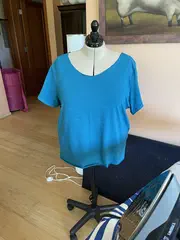
Pajama Lessons
The Machine is Not The Boss
Learning a new skill when you’re 46 is a lot different than learning it when you’re sixteen. I bet you think I’m going to say something about old dogs and new tricks. No! It’s because when you’re 46, you have a ton more perspective than you had at sixteen.
You know what occurred to me for the first time ever this week, as I was working on my pajamas?
The sewing machine is not the boss.
When I was sixteen, I thought literally everyone and everything, except me, was the boss. That is the life experience of a child, after all. I always assumed that if I wasn’t doing something well with the sewing machine, the problem was me and not the machine. Sewing machines are perfectly engineered to do every possible sewing machine better than a human, right? Why else would we invent them?
Take blind hems. I’ve struggled and perservered with blind hems on a machine, with mixed results, for as long as I’ve been sewing. It’s one of those skills my mom taught me, but I have to re-learn it every single time because it’s one of those weird spatial things where it makes no sense at the time and then as soon as the garment is three dimensional it’s perfect. (Theoretically, at least.)
So imagine my shock when I was watching Great British Sewing Bee one day and nearly every single sewer on the show did their blind stitch by hand. It’s very tricky to blind stitch on a machine, one said. (They’re British so they describe things as “tricky” and “rubbish” a lot.)
Wait. I could have been blind stitching by hand all this time? Instead of wrestling multiple layers of fabric beneath my presser foot and trying to make sure that one stitch out of ever six perfectly captures just a couple threads of fabric, I could have just done that myself??? If that had ever occurred to me, I would not currently have a pile of too-long pants that have been waiting for years to be hemmed.
The sewing machine is just a tool. And yes, my seams may be going all over the place because of my inexperience and lack of practice, but also possibly because I’m doing something that is tricky to do on a sewing machine. Or in general.
Anyway, on to the actual sewing.
Use a Lot of Pins
Is this my first time putting sleeves on anything? I think it might be. My dresses have always been sleeveless. I got to the part in the instructions where I had attach the sleeves to the torso. The diagram explains it thusly:
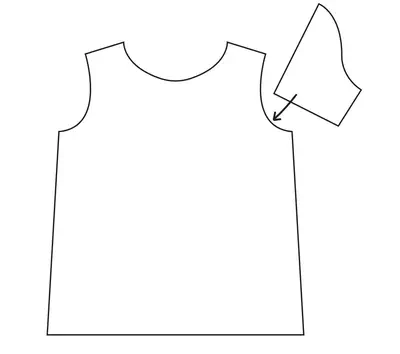
What? Those curves don’t match up, do they?? One looks longer than the other. One has just one simple curve and the other one has two curves. Why does sewing always seem to involve some kind of space-time voodoo?
(It got even worse when I had to attach pants legs together by putting one inside the other and the illustration made it come out looking like this:
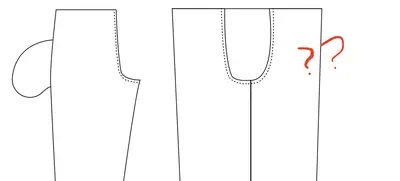
That is not what the seams looked like when they was done, I don’t know what that illustration is trying to indicate.)
Anyway, throughout these hair-raising experiences with the complete nonsense that is three-dimensional space, I muttered to myself: When in doubt, go slow, trust the process, and use lots of pins.
On Sewing Bee you’ll often see people zipping seams through their machine with no pins at all (you see the same thing on Drag Race with queens who really know what they’re doing), and some fabrics are so delicate that you can’t use pins, because they’ll leave holes. So those fabrics are not for me, yet. I will use all the pins.
It turned out that the curves did match, but I was right that one had a little more fabric in it than the other. My first sleeve wound up with a tiny pucker because I didn’t use enough pins to distribute the extra evenly. My second sleeve encountered a mishap in which the fabric insisted on walking out from under the needle no matter what I did to try to guide it in a straight line. You could say both sleeves look a little bit rubbish.
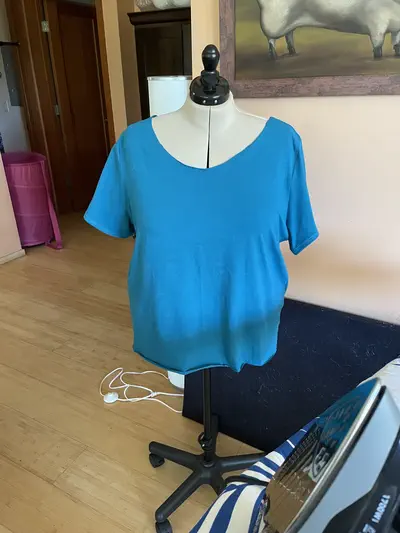
At any rate, the sleeves were attached, and presto-change-o, you turn the whole thing right-side out and somehow it has become a shirt.
Sewing is Expensive
The solid-colored jersey I purchased for this project was $9 a yard, and I needed four yards. $36 (plus tax and shipping and whatever) is pretty comparable to what you’d pay for a pajama set at a place like J. Crew, so not outrageous.
But when you start looking at prints—nice-looking prints, anyway—the price goes up fast. Spoonflower.com has my favorite fabrics (they are a print-on-demand outfit that allows users to upload designs to be printed on different materials, and they have thousands of really beautiful designs people have made) but their cotton jersey runs $23 a yard, meaning a set of pajamas is nearly $100.
I would never normally pay $100 for pajamas. I shop at Target, where a set of pajamas (probably polyester) is like twenty bucks. But compared to my Target pajamas, the jersey I bought is nice and thick, and probably won’t wear through in a couple of washings. I wear my pajamas a lot, too. Way more than my normal clothes. If I’m at home, I’m in pajamas.
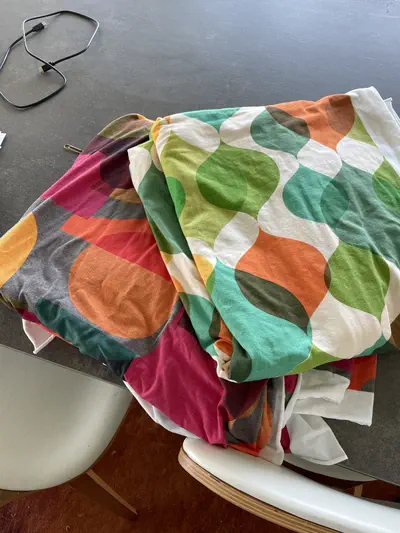
printed jersey from Spoonflower waiting to be turned into more pajamas
I realized I have no idea what good quality pajamas cost, so I did some research.
MeUndies: $88
BedHead: $108
The Cat’s Pajamas: $125
The Pajama Company: $125
Pajamagram: $70
You get the idea. Of course, I’m comparing material cost to the cost of a finished product, and not factoring in my labor. But I’m doing it for fun, so I spend the same amount of money, enjoy myself, and improve my skills; so as far as I’m concerned I come out ahead.
Measure Twice?
Anyway, this story has already gotten too long so let me skip to the end: the pajamas are done! This project was my first time: using stretchy fabric; putting in sleeves; making pants; adding a pocket. By the time I got to the pants, I’d gotten a lot better at seams and I don’t think they have any puckers, unlike the unfortunate shirt.
Aaaannnnd they’re too big. Not unusably too big — I cut a few inches off the elastic waist so at least they don’t fall down, but it is similar to wearing sails. I need to figure out how I got my sizing off by so much, but anyway next time I’ll size down.
Overall, I’d say that my experiment with stretchy cloth was a success! I have a pair of wearable pajamas (even if, as my husband pointed out, they look like scrubs). I learned some tricks for dealing with stretch fabrics under the needle. I learned that sleeves and pants are a magic trick. I learned that I need to be a little more careful when choosing a size and figure out whether the amount of ease the designer had in mind is the amount of ease that I want.
More pajamas are on the way, but my for next projects I’ll be moving on to something new: making a dress for someone who is not me, and making a very cool purse that I could not be more excited about.
Also, I may finally hem all those pants!
